Rwenzori Trekking: The Expert Guide to Africa’s Rwenzori Mountains.
Plan your Rwenzori trekking expedition with Africa’s specialist. Routes, costs, gear, peaks & itineraries: expert advice from guides who know every inch of the Rwenzori Mountains.
Discover expert-guided treks in the Rwenzori Mountains from Weismann Peak to Mount Stanley and Mount Baker. Our Rwenzori expeditions feature professional guides, safe routes, unbeatable views, and full support as we explore the legendary Mountains of the Moon.
Join Rwenzori Trekking Safaris for an exciting Rwenzori Mountaineering Safari, led by our expert mountaineering guides. The Rwenzori Mountains, also known as the “Mountains of the Moon,” provide a stunning setting for a challenging and exciting African trekking journey. Enter a universe where every path has a narrative, exotic rainforests conceal unusual animals, and clouds kiss old glaciers.
There is a moment, somewhere on the second day of a Rwenzori trek, when the montane forest closes above you like a cathedral vault, and the sounds of the world below, the road noise from the Kasese Valley, the voices at the trailhead, and the last signal from your phone dissolve completely. You are inside the mountain now, moving through a world of dripping moss and enormous ferns and birdsong you have never heard before. The trail underfoot is steep and soft with decades of accumulated vegetation, and the air is thicker with moisture than anything you have experienced on a mountain. This is Rwenzori trekking, and it is unlike anything else in Africa.
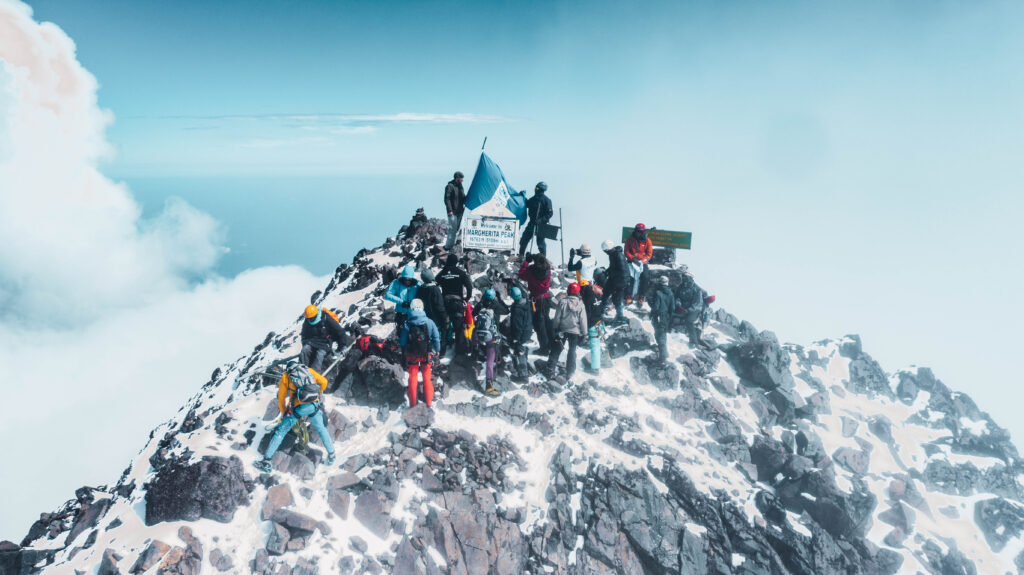
I have guided in these mountains for many years. I have stood on Margherita Peak more times than I can easily count, and I have watched the expression on a trekker’s face when the cloud finally lifts and the Stanley Plateau materializes, a frozen high-altitude plain sitting on the equator, ringed by glacial ice. That expression is always fresh. The Rwenzori Mountains, the Mountains of the Moon of ancient legend, are not merely Uganda’s highest peaks. They are one of the most extraordinary mountain environments on earth, and trekking in them is one of the defining wilderness experiences available to serious mountain travelers anywhere in the world.
This Rwenzori trekking guide is for people who are seriously researching a trek in the Rwenzori Mountains of Western Uganda. This guide is for you; it covers everything: the routes, the peaks, the experience of summit day, the difficulty, the gear, the best time to go, what it costs, how to prepare, and why the Rwenzori Mountains reward the trekkers who choose them with an experience entirely unavailable on any other mountain on the continent. By the end, you’ll know if the Rwenzori is the right mountain for you and how to plan your trip.
The Rwenzori Mountains: A Brief Portrait of the Range
The Rwenzori range is the most spectacular and untouched hiking spot in East Africa. This UNESCO World Heritage site is a haven for those seeking a true tropical African wilderness experience amidst verdant valleys, snow-capped tropical peaks, and untamed glaciers. Its peaks rise gloriously above 5,000 meters. You can trust our professional guides to lead you safely through this pure and spectacular terrain to the peak of one of the world’s most stunning mountain ranges, the “Rwenzori Mountains.” Regardless of your degree of mountaineering or hiking experience, our bespoke safaris offer an unparalleled opportunity to conquer these legendary Rwenzori peaks and discover Uganda’s most intriguing hidden jewel.
Before planning a Rwenzori trek, it helps to understand what kind of mountain system you are entering. In contrast to Kilimanjaro and the Virungas, the Rwenzori are not volcanic. They are a block mountain system of ancient Precambrian crystalline rock thrust upward along the western branch of the East African Rift System over millions of years. The range stretches approximately 120 kilometers along the Uganda-DRC border, protected on the Ugandan side within Rwenzori Mountains National Park, a UNESCO World Heritage Site covering around 1,000 square kilometers. The park was designated a UNESCO site in 1994 and a Ramsar wetland in 2008, recognizing its extraordinary ecological value and its role as a major water tower for central and eastern Africa.
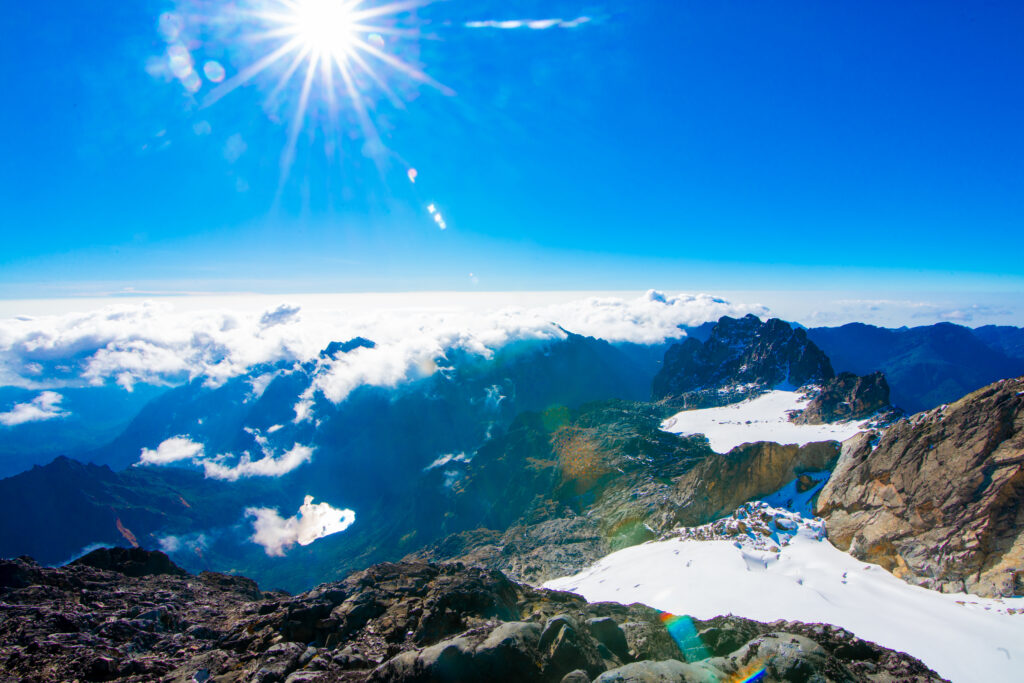
The Rwenzori are not one mountain but six distinct massifs, each with multiple named peaks. Understanding their individual characters is important for planning your trekking objectives. At the apex of the range stands Mount Stanley at 5,109 meters, which is home to Uganda’s highest point, Margherita Peak, and is flanked by the heavily glaciated Stanley Plateau. Below it in elevation come Mount Speke (4,890 m), Mount Baker (4,843 m), Mount Emin (4,798 m), Mount Gessi (4,715 m), and Mount Luigi di Savoia (4,627 m). A Rwenzori trekking expedition can target a single summit or, for those with time and ambition, multiple peaks in sequence.
The glaciers of the Rwenzori Mountains are among the last remaining equatorial glaciers in Africa. Since 1906, they have retreated by over 80%, and projections indicate that they will disappear entirely within the coming decades. This is both a conservation crisis and a compelling reason to trek the Rwenzori now, while the experience of crossing glacial ice on the equator is still available. This experience will not exist for future generations if current climate trends continue, and it adds a dimension of witness and urgency to the summit day that is entirely absent from other African mountains.
Why Rwenzori Trekking Stands Apart From Every Other Mountain in Africa.
Africa has magnificent mountains. Kilimanjaro is iconic. Mount Kenya is technically demanding and scenically beautiful. The Virungas are extraordinary in their volcanic way. But Rwenzori trekking occupies a category entirely its own, and the reason is not simply altitude. The reason is everything that surrounds and constitutes the trekking experience: the landscape, the biodiversity, the remoteness, the depth of the wilderness, and a quality of strangeness, a sense that you have entered a world operating by its own internal logic, unmatched by any other African mountain.
Consider the numbers first. The Rwenzori receive roughly 1,000 trekkers per year across all routes. Kilimanjaro receives upwards of 50,000. The Rwenzori are, in statistical terms, fifty times less visited than their more famous East African rival, yet they are arguably richer in biodiversity, more challenging in terrain, and, for those who reach the summit, more physically demanding and more genuinely rewarding. The exclusivity of a Rwenzori trekking experience is not a marketing claim; it is the simple consequence of a mountain that asks more of its visitors and therefore attracts fewer of them. As documented in our visitor statistics analysis, these mountains offer something increasingly rare in adventure travel: genuine wilderness that has not been processed for mass consumption.
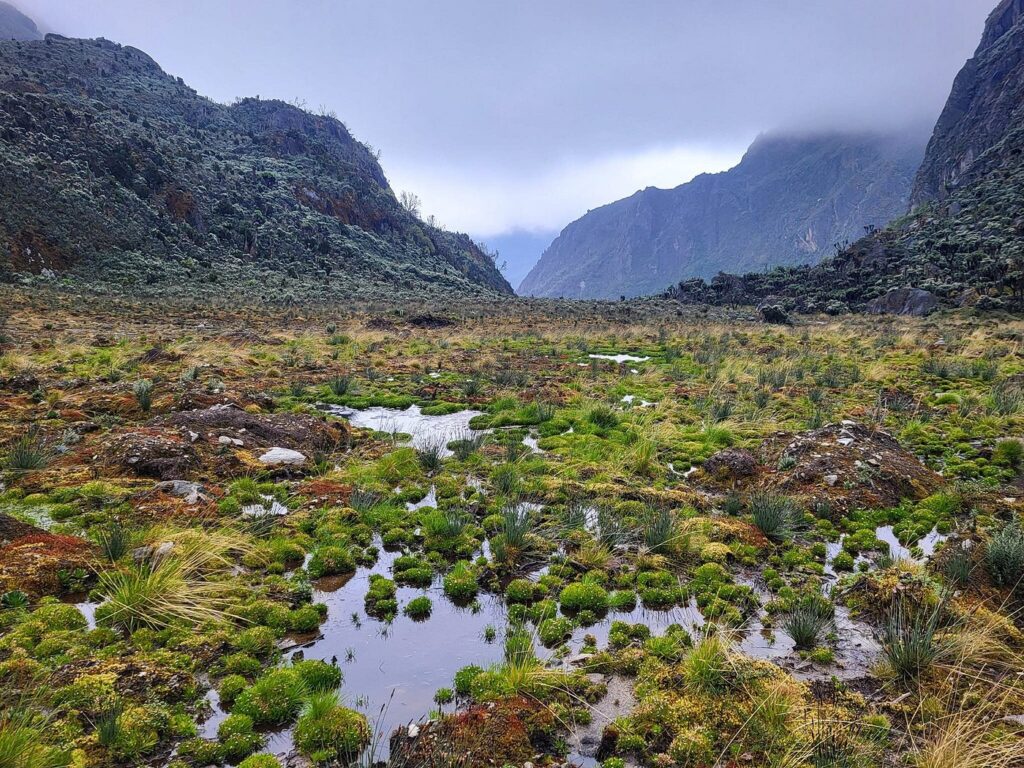
There is also the matter of the landscapes. The Rwenzori’s five vegetation zones montane forest, bamboo forest, heathland, Afro-alpine moorland, and the nival zone are more biologically diverse and more visually dramatic than the equivalent zones on any other African mountain. The Afro-alpine zone in particular, with its three-meter giant lobelias and five-meter giant groundsels, produces a landscape so botanically alien that even experienced mountain travelers consistently describe it as the single most surreal environment they have encountered. The Rwenzori is a mountain that surprises repeatedly, deeply, and genuinely.
The trekkers who have climbed both the Rwenzori and Kilimanjaro most often ask me, “Which is better?” My honest answer is that they are different experiences, not competing ones. But if I had to choose a mountain to climb once for the landscapes, the wildlife, the sense of genuine wilderness, and the feeling of being somewhere truly apart from the world, I would choose the Rwenzori without hesitation.
Rwenzori Trekking Itineraries: Every Option From One Day to Eighteen.
One of the most important things to understand about Rwenzori trekking is the range of itinerary options available. The full Rwenzori trek portfolio spans everything from a single day in the forest to an 18-day expedition summiting every major peak in the range. This is not a mountain with a single route and a single objective; it is a complex system that accommodates trekkers of vastly different experience levels, time availability, and ambition.
You probably want to climb the Rwenzori Mountains, aka the Mountains of the Moon, since you landed on this site. If that is the case, then I must say, well done! A wonderful goal is within your reach. The result is a goal you can proudly look back on and cherish for a lifetime! Are you considering climbing the Rwenzori Mountains?
Here’s all the info you need, including our Rwenzori expert-recommended routes. Get in touch with our Rwenzori trekking experts if you want to know where to go on hiking trips that are safe and where to view mountain gorillas in East Africa. To begin organizing your Rwenzori Trekking safari, contact our Rwenzori Trekking team of professionals.
Short Treks: Forest and Lower Mountain (1–4 Days)
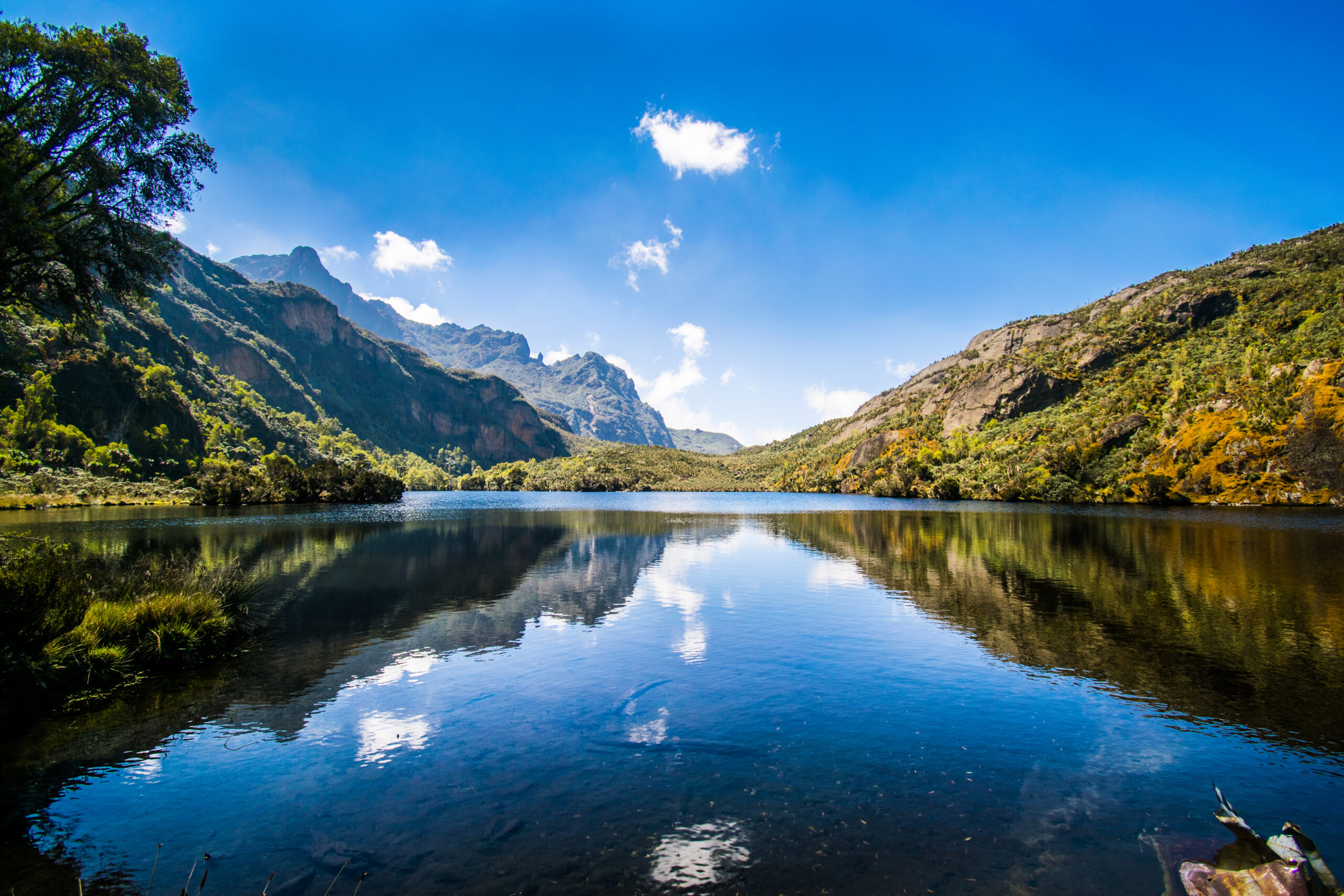
For those combining the Rwenzori with a broader Uganda itinerary, or for those wanting to gauge the mountain before committing to a longer expedition, the short trekking options are excellent introductions to the range. The 2-day trek to Sine Camp takes you deep into the montane forest on the Kilembe Trail, with opportunities for birdwatching, three-horned chameleon sightings, and genuine forest immersion in a 9.5-kilometer return journey. The 2-day Lake Mahoma hike is another outstanding short option, approaching one of the range’s most beautiful alpine lakes through richly biodiverse forest.
The 4-day Mutinda Lookout trek is the most ambitious of the shorter options, ascending to approximately 4,000 metres on the Kilembe Trail for panoramic views of the upper mountain before descending. This trek employs the “climb high, sleep low” acclimatization principle and is used by many guides as an excellent preparation exercise for trekkers considering a future full summit attempt. The 3-day Mahoma Loop and the 3-day Sine Camp and Samalira Falls offer comparable immersion in the forest and heathland zones with a slightly longer time on the trail.
Summit Day: What Rwenzori Trekking Feels Like at the Top.
Every trekker who reaches Margherita Peak carries a different story to the summit. But the broad outlines of summit day are constant enough that I can give you a reliable picture of what to expect, and understanding this experience is an important part of deciding whether the Rwenzori is the right mountain for you.
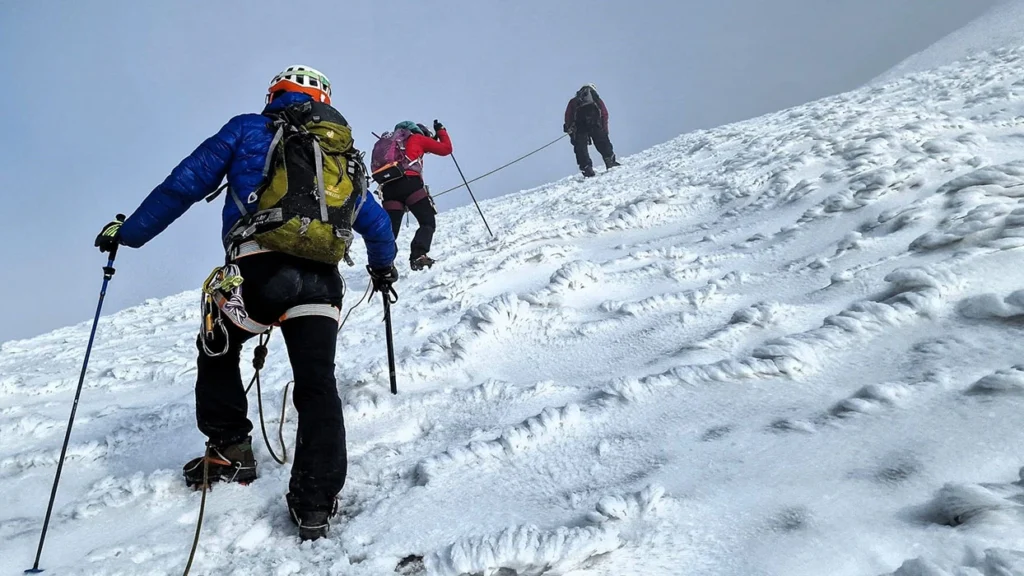
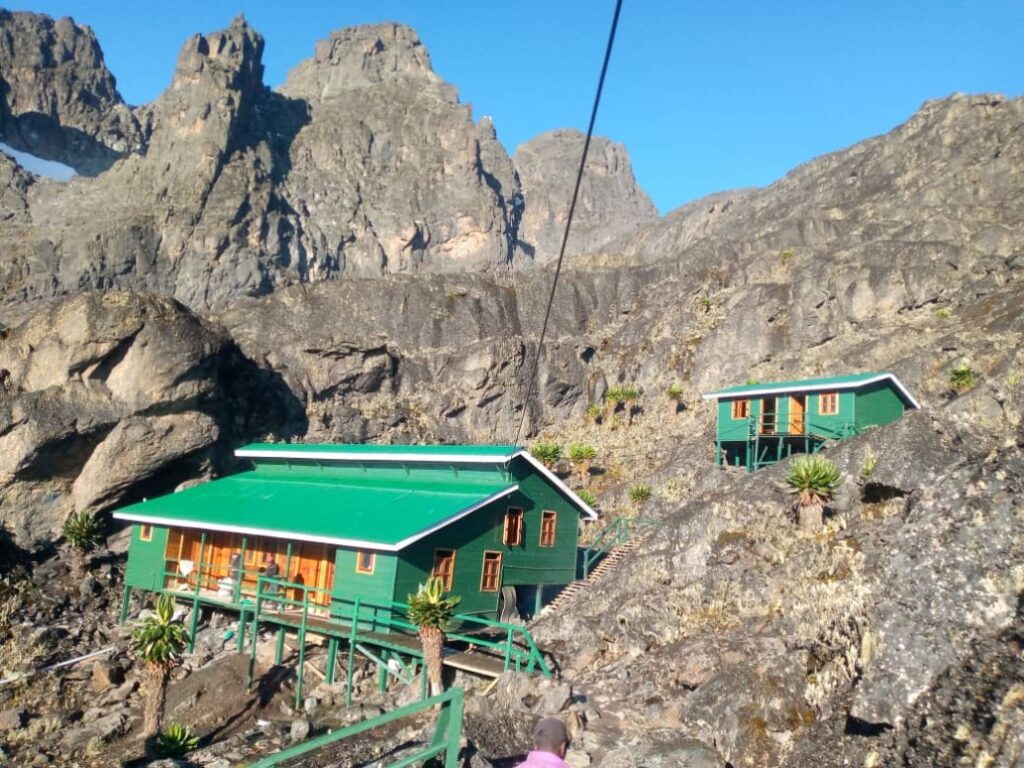
The summit push begins in the early hours, typically at 2:00 or 3:00 AM, from Elena Hut at 4,541 meters. The darkness is absolute. Temperatures at this altitude regularly drop below zero overnight, and the start of the approach involves layering up fully in the cold hut kitchen while your guide checks equipment and briefs the team. You move out into the dark with headtorches, crossing the rocky ground below the Elena Glacier before the first light begins to gray the sky to the east. The glacier itself is accessed via fixed ropes on steep rock above the hut, a section that requires crampons and an ice axe, fitted and checked by your guide before departure.
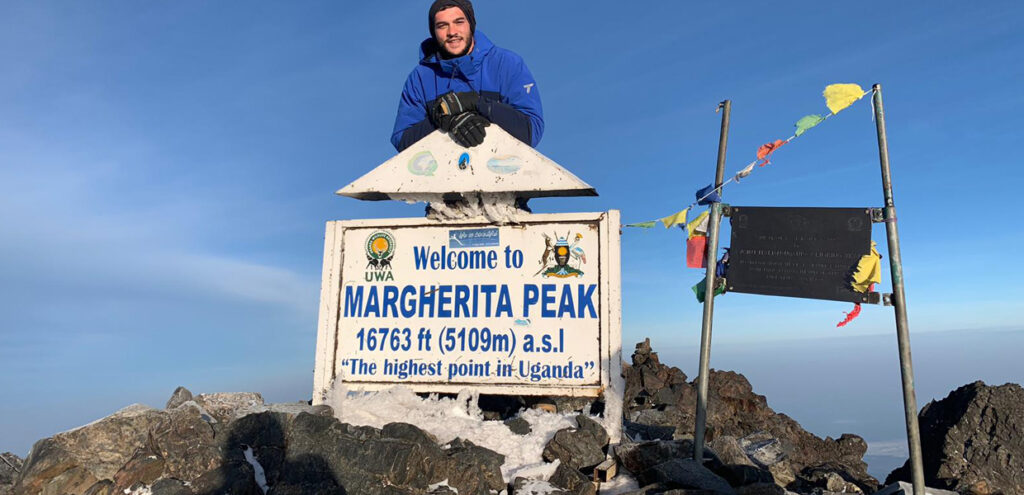
Once on the Stanley Plateau, the world changes. You are on a high-altitude ice sheet, moving across permanent glacial terrain at the equator, one of the rarest and most extraordinary environments on earth. The summit itself, Margherita Peak at 5,109 meters, is reached by a final steep snow slope, and the views on a clear day extend to the Congo Basin to the west and the Ugandan plains to the east. The return to Elena Hut, typically completed by late morning, reveals the same landscape in daylight that you traversed in the dark, and it rarely disappoints. A detailed and honest account of what the Margherita Peak climb actually involves provides the full picture of each day’s journey.
On every Rwenzori trekking expedition, summit day is both the hardest and the most memorable. The cold start, the glacier crossing, the plateau, and the final push are experiences that stay with people for the rest of their lives. But I want to be honest: summit day works best when you are well prepared and well acclimatized. Rushing to the summit on a short itinerary is the single most common reason for failed attempts. Give the mountain the time it asks for.
How Hard Is Rwenzori Trekking? An Honest Difficulty Assessment.
A complete, honest assessment of the Rwenzori trek’s difficulty is one of the most important things to read before committing to this mountain. The short answer is this: Rwenzori trekking is harder than Kilimanjaro, and the reason is primarily the terrain rather than the altitude. Understanding this distinction is critical for planning.
Kilimanjaro’s summit at 5,895 metres is 786 metres higher than Margherita Peak. In altitude terms, Kilimanjaro wins. But Kilimanjaro’s trekking terrain is, for the most part, straightforward, well-maintained paths on a conical volcano with clear sightlines and predictable gradients. The Rwenzori mountains do not provide any of these comforts. The lower trails are saturated bogs where each step requires concentration; the middle sections combine steep rock and root-climbing with mud of extraordinary depth; the afro-alpine zone presents terrain that is technically complex, navigationally demanding, and exposed to weather that shifts from sunshine to whiteout in twenty minutes.
The three principal difficulty factors on a Rwenzori trekking expedition are as follows: First, the terrain is complex, with mud, roots, bogs, and steep loose rock, which demand strong ankles, confident footwork, and genuine physical fitness. Second, the technical demands of summit day include a glacier crossing and rock sections above Elena Hut, which require crampons, ice axes, and the ability to follow instructions on steep mixed terrain. And third, altitude: while Margherita’s 5,109 meters is lower than Kilimanjaro’s summit, altitude sickness is a genuine risk that requires a careful acclimatization strategy built into the itinerary. None of these challenges are insurmountable with proper preparation. All of them are manageable with professional guiding.
For those asking whether they qualify for this mountain, the guide for first-time trekkers addresses the question directly. The guide for older trekkers, those over 50 or 60, provides a genuinely honest account of what older, fitter trekkers can achieve on the Rwenzori, drawing on our experience guiding clients in their sixties and seventies to Margherita Peak.
Training for Rwenzori Trekking: How to Prepare Your Body
The trekkers who arrive physically prepared almost always have the best experiences on the Rwenzori, summiting successfully, enjoying the journey rather than just enduring it, and returning to do it again. Our 16-week training plan was developed specifically for Rwenzori trekking conditions and targets the physical qualities that the mountain actually tests: cardiovascular endurance for sustained steep ascents, lower-body strength for uneven and heavily loaded terrain, ankle stability for the lateral demands of root and rock climbing, and core strength for balance and back support on rough ground.
The single most revealing training exercise for a Rwenzori trekker is loaded hiking, walking with a weighted pack over uneven terrain, ideally including steep descents, for three or more hours at a stretch. This is the movement pattern the mountain will require of you for six to eight hours per day, and the specific fatigue it produces cannot be replicated on a treadmill or a flat park path. If you have access to hills, use them. If not, stair climbing with a loaded pack is a reasonable substitute for building the leg strength required. Our fitness guide provides a full assessment of the baseline fitness required for different Rwenzori itineraries.
Gear and Equipment for Rwenzori Trekking
Rwenzori trekking demands gear choices that differ in important ways from those appropriate for drier mountains. The complete Rwenzori packing list covers every item in detail, but the headline principle is this: the Rwenzori is a wet, cold, technically demanding mountain, and your gear must match all three of those qualities simultaneously.
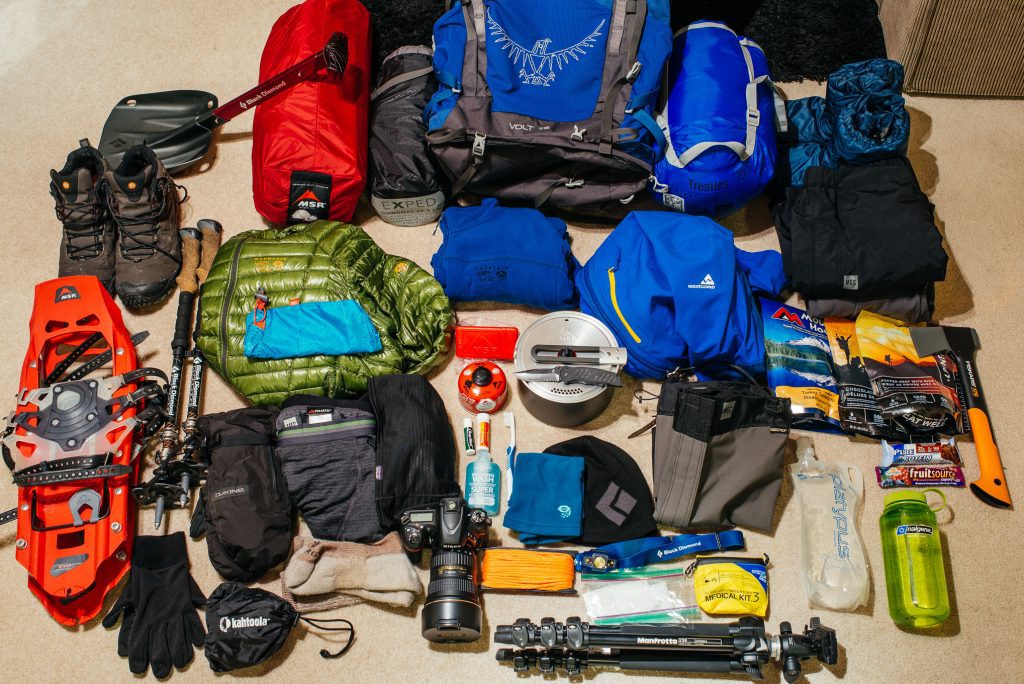
The most critical gear decision is footwear. The standard advice, “sturdy waterproof hiking boots,” is inadequate for the Rwenzori’s terrain. What this mountain actually requires are rubber Wellington-style boots, worn over neoprene socks and with gaiters for the lower sections. The reasons are explained in full in our Rwenzori boot guide, but the core issue is this: no conventional hiking boot, however waterproof and expensive, will stay dry in the Rwenzori’s deep bogs. Rubber boots that provide waterproof protection from the sole up and warm liners are the only footwear that genuinely works on this mountain. Getting this decision wrong is one of the most common sources of misery on a Rwenzori trekking expedition and one of the most easily preventable.
Beyond footwear, the key gear priorities are a sleeping bag rated to at least minus ten degrees Celsius (Elena Hut drops below freezing overnight); a high-quality waterproof jacket and trousers that can sustain all-day rain without deteriorating; a layering system capable of managing everything from humid 25-degree forest to sub-zero summit conditions; trekking poles (essential for bog navigation and steep descents); and a headtorch with spare batteries for the pre-dawn summit start. Your guide team provides crampons and ice axes, which are included in the expedition costs; you do not need to bring your own.
Best Time for Rwenzori Trekking.
The best time to visit the Rwenzori requires more nuance than the standard East Africa answer of “dry season only.” Unlike Kilimanjaro or the volcanoes of the Virungas, the Rwenzori receive precipitation year-round. There is no month in which you will not encounter some rain on a Rwenzori trekking expedition. What varies between the seasons is the intensity of that rain and its effect on trail conditions and summit visibility.

The two preferred trekking windows are December through February and June through August. During these periods, the weather reduces rainfall, makes trail conditions more manageable, and creates more frequent summit weather windows. June to August are the busiest peak season months that attract the highest number of annual visitors, though “busy” on the Rwenzori means encountering perhaps a handful of other trekking parties on the mountain, not the queuing and congestion of Kilimanjaro’s high season.
The wet season months, March through May and October to November, bring heavier and more sustained rainfall, muddier and more challenging trails, and reduced summit visibility. They also bring a significant reduction in the number of other trekkers, lower prices on combination packages, and an atmosphere of intensified wildness that many experienced mountain travelers actively prefer. The Rwenzori in mist and rain is not a diminished experience; it is a different and in many ways more atmospheric one. With properly waterproof gear, an experienced guide, and the right expectations, the wet season is a legitimate and rewarding time for Rwenzori trekking.
The Cost of Rwenzori Trekking
A fully guided Rwenzori trekking expedition to Margherita Peak, covering all mandatory park fees, guide and porter wages, mountain hut accommodation, and agency logistics, typically costs between USD 1,200 and USD 3,500 per person for a 7–8-day itinerary. The complete 2027 cost breakdown provides exact per-person pricing for every itinerary in our program, covering the different cost structures for solo trekkers, pairs, and larger groups.
It is worth comparing the Rwenzori directly with Kilimanjaro. A comparable 7–8-day guided Kilimanjaro summit expedition through a reputable operator typically costs USD 2,500 to USD 4,000 or more per person, driven by Tanzania’s relatively high park fees and the intensely competitive guide and porter market on the mountain. The Rwenzori offers, by any measure, a more challenging, more exclusive, and more biodiverse mountain experience at a lower overall cost. For those looking to manage expenditure further, the budget trekking guide identifies legitimate cost-reduction strategies without compromising the quality or safety of the expedition.
Your Guide and Porter Team: The Heart of Every Rwenzori Trek.
Rwenzori trekking is not a self-guided activity. The Uganda Wildlife Authority requires all trekkers within the national park to be accompanied by a UWA-certified guide at all times, a requirement that reflects both the genuine navigational complexity of the terrain and the important economic role that mountain tourism plays in supporting the Bakonzo communities of the Kasese region. Every guide and porter working with Rwenzori Trekking Safaris is a certified, experienced Bakonzo mountain professional whose family has lived on these slopes for generations.
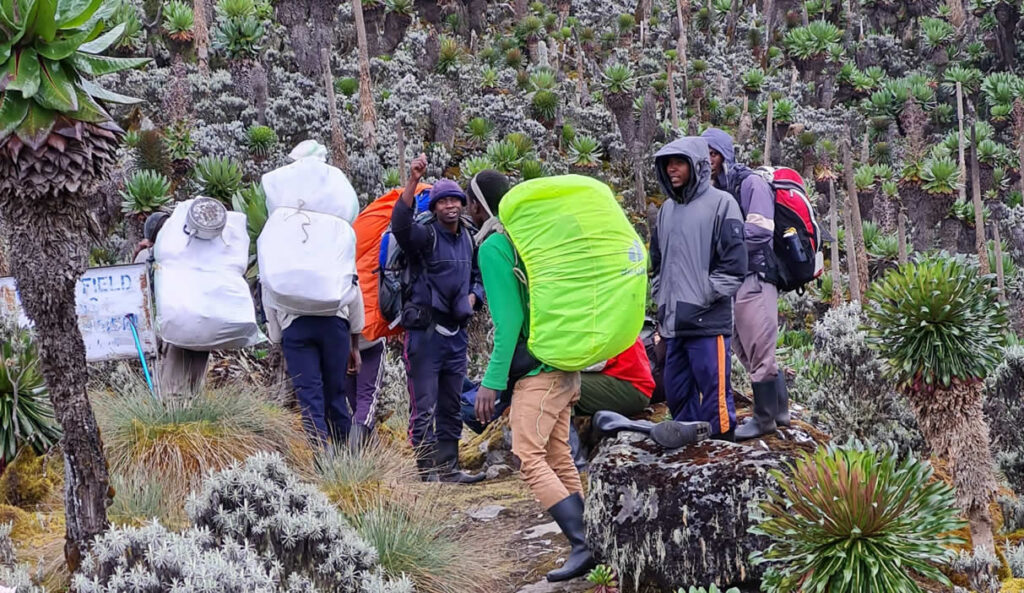
The relationship between a trekker and their guide on a Rwenzori expedition is different from the guide experience on many other mountains. The Rwenzori is genuinely complex terrain; there are many junctions, many misleading paths, and many conditions under which navigation without expert local knowledge would be dangerous. Your guide is not a formality; they are the single most important factor in the success and safety of your trekking experience. The full guide to Rwenzori porters and guides explains the structure of the team, what each member carries and does, and how the expedition logistics are managed from the first day to the last.
Tipping your guide and porter team is a critical component of responsible Rwenzori trekking. These are hardworking mountain professionals carrying significant loads in difficult conditions, and the income they earn directly supports families and communities in an economically marginalized region. Our porter tipping guide provides clear norms and the standard ceremony for distributing tips at the end of an expedition.
Health and Safety on a Rwenzori Trekking Expedition
The complete medical guide to Rwenzori trekking covers altitude sickness, hypothermia, trench foot, and the full range of health challenges that these mountains present. The most important principle to understand from the outset is that altitude sickness is real at 5,109 meters and requires conscious management throughout the expedition. The Rwenzori’s wet, cold conditions mean that the signs of mild AMS, headache, fatigue, and reduced appetite can be obscured by the general physical demands of the trail, making experienced guide monitoring especially valuable. Any guide worth their certification tracks trekkers daily for altitude symptoms and enforces descent if those symptoms worsen.
Two factors closely correlate with the summit success rate for Margherita Peak: itinerary length and the quality of guiding. Well-prepared trekkers on 8-day or longer itineraries with experienced guides achieve very high success rates. The most common cause of failure is not physical unfitness but inadequate acclimatization, a problem that longer itineraries directly address. The safety record of Rwenzori trekking is excellent when expeditions are managed professionally, and the mountain has never had the kind of mass-casualty incidents associated with overcrowded high-altitude peaks elsewhere in the world.
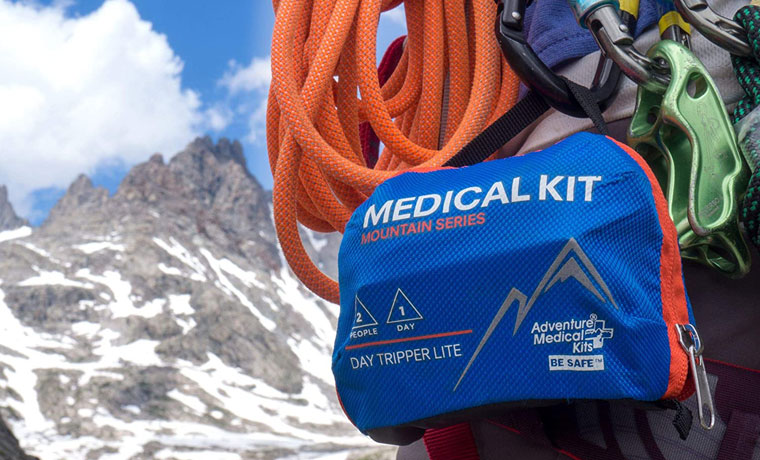
Travel insurance for a Rwenzori trekking expedition is non-negotiable. Standard travel insurance policies typically exclude high-altitude rescue and emergency helicopter evacuation, both of which are real possibilities on the Rwenzori. The Rwenzori travel insurance guide specifies exactly what cover is required: helicopter evacuation, high-altitude rescue, emergency medical treatment at altitude, and trip cancellation or curtailment. Obtain this cover before you travel.
Getting to the Rwenzori: Travel Logistics
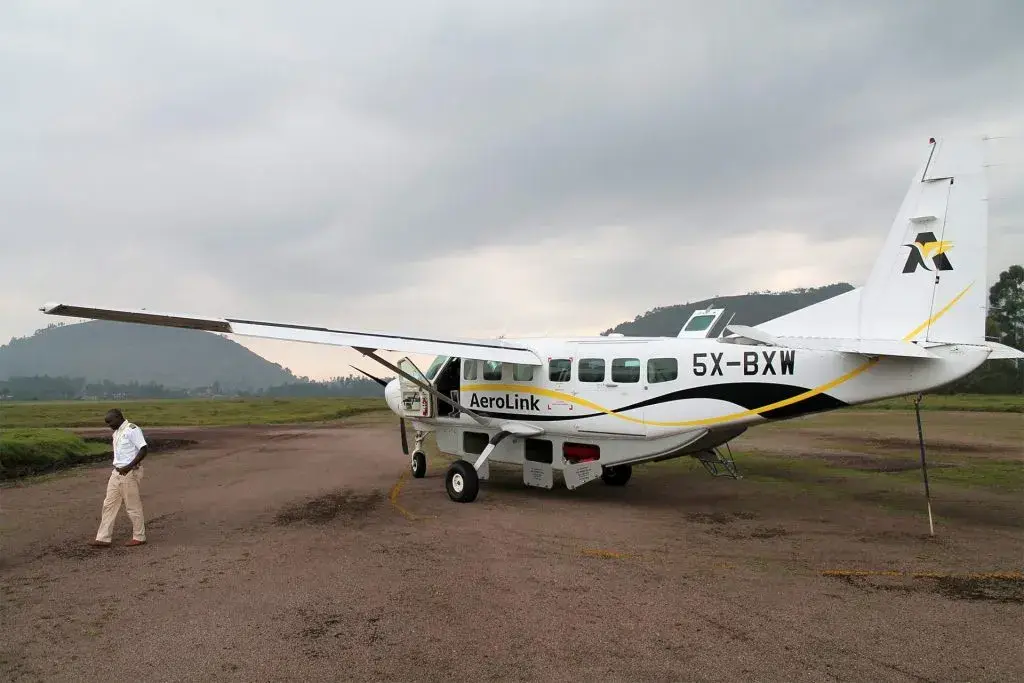
The gateway to Rwenzori trekking is Kasese town in western Uganda, approximately 420 kilometers from Kampala by road. The standard travel approach from Entebbe International Airport involves either a domestic flight to Kasese Airport, a small regional airstrip served by Fly Uganda and Eagle Air on certain days, or the overland transfer by private vehicle, which takes approximately five to six hours via the Fort Portal road and offers the first views of the Rwenzori range appearing on the western horizon as you approach Kasese. The complete travel guide to reaching the Rwenzori covers all options, including public bus, shared taxi, and charter transfer.
Most trekkers spend one night in Kasese before the trek begins and at least one night after, and there is a growing range of accommodation available in and around the town. The pre- and post-trek accommodation guide covers all options, from budget guesthouses to comfortable lodges, including several options near the Kilembe trailhead and on the outskirts of Kasese, as well as near the Central Circuit trailhead at Ibanda.
Combining Rwenzori Trekking With Uganda’s Wildlife.
Uganda is arguably the most wildlife-rich country in East Africa per square kilometer, and the Rwenzori sit at the heart of a region dense with national parks and extraordinary natural experiences. Combining Rwenzori trekking with a broader Uganda safari itinerary is, in my experience, the finest two-week itinerary available anywhere in Africa, and it is one that we design and operate every week of the year.
The most popular combination is Rwenzori trekking, followed by gorilla trekking in Bwindi Impenetrable Forest, a journey of approximately four hours from Kasese to the gorilla sector of your choice in Bwindi. The experience of going from a high-altitude glacier crossing one week to sitting on a forest floor in the presence of mountain gorillas the next is extraordinary, and no other itinerary in Africa delivers that breadth of experience within a two-week window. Our 12-day Rwenzori trekking and gorilla safari is purpose-built for exactly this combination, and it has become one of the most requested itineraries in our program.
The region immediately surrounding the Rwenzori also contains Queen Elizabeth National Park to the south, famous for its tree-climbing lions, Kazinga Channel boat safari, and one of Africa’s most diverse bird lists. Further combinations are possible with chimpanzee trekking in Kibale Forest, the extraordinary Murchison Falls in the north, and white-water rafting on the Nile at Jinja. The 19-day grand Uganda adventure brings all of these together into a single itinerary for those who have the time to experience Uganda comprehensively.







 Totally Tailor-Made